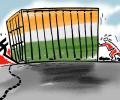
The United States and the European Union have strongly criticised India's trade policies at the World Trade Organization review, highlighting concerns over high tariffs, quality-control orders (QCOs), and restrictions on digital trade and services, which they argue undermine India's economic openness.

BRICS members have expressed 'serious concerns' over the unilateral imposition of trade and finance-related measures, including higher tariffs and non-tariff barriers, stating these actions distort trade and are inconsistent with WTO rules. The grouping also highlighted elevated risks to the global economic outlook due to geopolitical tensions, trade fragmentation, and protectionism.

India has strongly refuted claims by the United States Trade Representative (USTR) regarding excess capacity in its steel and textile sectors, arguing that the nation's significantly low per capita consumption of these products contradicts such assertions, according to Amitabh Kumar, Additional Secretary in the Ministry of Commerce.

In a world fractured by uncertainty, India stands out for its policy consistency, paired with sustained ambition, points out Pritam Banerjee.

Taking Kharg would give the US control over virtually all of Iran's oil exports and thus provide significant leverage, notes Prem Panicker in his must read daily blog on the Gulf War. It would also put American troops within range of Iran's remaining missiles, drones, and artillery on a piece of real estate that is just eight square miles in size, and just 15 miles from the Iranian mainland.
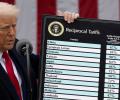
US President Donald Trump has proposed a deal to China that would see the sale of TikTok's US operations to an American buyer in exchange for a reduction in tariffs on Chinese exports to the US. The proposal comes amid a trade war between the two countries and follows China's retaliation of Trump's tariffs on Chinese goods. Trump has also said that tariffs are a powerful economic tool and that he is determined to ensure fair trade between the US and China.
If the US' renewed closeness with Pakistan ends up strengthening Pakistan's military, it will clearly show that Washington no longer wants a strong India and could be ready to let China dominate Asia, notes Colonel Anil A Athale (retd).
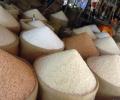
India believes rich nations should be away from farm subsidies.

It was government policies, not ITA-I, according to a recent study.

India has been opposing the pact as ITA will only benefit the country when its domestic manufacturing is robust.
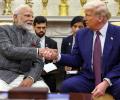
India should convert the Trump threat to an India opportunity, re-embracing a more liberal trade regime as a way of reviving manufacturing output and exports.

The United Kingdom extracted USD 64.82 trillion from India over a century of colonialism between 1765 and 1900 and USD 33.8 trillion of this went to the richest 10 per cent -- enough money to carpet London in notes of 50 British pound almost four times over.

With China's entry into the WTO, India is likely to make strong gains in food grains and light manufacturing and modest growth in several other sectors but is likely to lose export shares in markets such as the US and EU especially in textiles.

The report was jointly prepared by the Paris-based Organisation for Economic Cooperation and Development and the World Trade Organisation.
The study paper by Melbourne-based think-tank Australia India Institute titled 'The G20: Challenges and opportunities Ahead', said following Prime Minister Narendra Modi's visit to the US and his talks with US President Barack Obama, India may finally sign the agreement.

Critics have even suggested that India is doing this because it is not prepared to take on the requirements of TFA, with a relatively weak trade infrastructure.

Commerce minister makes strong case for food subsidy to poor.
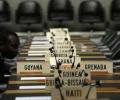
The differences between the rich and developing nations have always been at the core of the World Trade Organisation, set up in 1995 to facilitate greater trade flows across the world, and it came as a major breakthrough when the US and India reached a deal over food security issues in 2014.
Trade ministers from 162 WTO countries will gather in Kenya's capital from Dec. 15-18 to work on an agreement to liberalise global trade.

The US side had pushed for removal of price caps on medical equipment such as coronary stents and a commitment by India to reduce trade imbalance
India was on Friday guarded in its reaction to European Union farm ministers' 'historic' accord to reform its disputed Common Agricultural Policy.

While an official in the Commerce Department indicated a trade war was in the offing, till now the government has been in wait-and-watch mode.
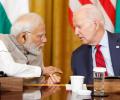
'Every type of deal that US government officials were privately indicating 'hope' to have included a few months back made it in.'
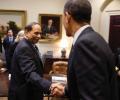
Ambassador Islam A'Isi' Siddiqui -- who recently resigned from his position as chief agricultural negotiator in the office of the United States trade representative -- has joined the Center for Strategic and International Studies as senior adviser on Global Food Security.
The country could be a major beneficiary from greater market access in services unlike other developing nations, said the working paper authored by H A C Prasad, senior economic advisor in the ministry. India is Asia's third largest economy with a size of nearly $1 trillion. Services contribute about 61 per cent of GDP and the sector is growing at double-digit rates.
Stoutly opposing the move to expand the WTO agenda to include new issues, India on Monday cautioned against the pitfalls of including the Singapore issues in the work programme.

India has stated that the move would impact Indian IT professionals.

'China feels India will be hard-pressed not to go after China because we are so badly dependent on them -- and that is the reality.'
A feasibility study on the proposed Free Trade Agreement, officially known as the Comprehensive Economic Cooperation Agreement, has long been finalised but cannot be acted upon in the absence of Russia joining the WTO.

Balachandran said that he would encourage Kamala Harris like any other parent and advice her to continue the good work.
The US has hailed India's recent move to withdraw the additional duty on beer, wine and distilled spirits, saying it was a positive step.
A domestic policy group would focus on issues related to service taxes, Data Protection Act and Indian Copyright Act. The international group would address global policy issues like WTO, besides visa and work permit matters.
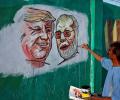
Existing trade deals, especially the 2009 pact with the Asean bloc, have been panned by the Centre for not boosting exports but flooding the domestic market with cheap imports. Subsequently, New Delhi has called for reviewing FTAs with Japan and South Korea. Going by that, a trade deal with the US is unlikely to be beneficial, say experts.

This is a high-stakes strategic conflict between a power which wants to preserve the status quo in its favour and one which wants to usurp that throne. The rest is all theatre, says Harsh V Pant.
Overseas education consultant NNS Chandra offers advice.

Special 301 Report expresses concern over weak IPR laws, to conduct reviews.
